TAFU

- All
- Product Name
- Product Keyword
- Product Model
- Product Summary
- Product Description
- Multi Field Search

Views: 0 Author: Site Editor Publish Time: 2026-09-09 Origin: Site


Improper tire specification carries hidden operational costs that quietly degrade heavy machinery. Running mismatched tires invites accelerated equipment wear, operator fatigue, and catastrophic tread failure. The tension between maximizing load capacity and navigating unforgiving operational surfaces requires a calculated approach. Selecting tires for your fleet is an engineering decision, not a commodity purchase. It directly impacts workplace safety and overall productivity.
You need a systematic evaluation framework to match tire compounds, tread profiles, and load ratings to specific duty cycles, vehicle types, and facility environments. By aligning the physical properties of the tire with the demands of the job site, you eliminate preventable downtime. This guide breaks down the exact mechanics of tire selection, helping you keep your operations moving safely and efficiently under heavy loads.
Load Rating Realities: Exceeding dynamic load limits on solid tires causes internal heat buildup and compound degradation, not just surface wear.
Surface-Driven Specification: Severely uneven terrain induces concentrated point loading, requiring specific tread patterns to prevent rapid tread chunking and structural failure.
Duty Cycle Impact: Continuous, high-speed operations degrade puncture proof solid tires faster than intermittent heavy lifting; speed ratings are as critical as weight limits.
Before upgrading your equipment, you must establish a clear comparative baseline between solid and pneumatic options. Validating the shift to Solid Tires requires weighing the complete elimination of puncture downtime against the loss of pneumatic shock absorption. Air-filled tires provide a natural cushion that protects the vehicle chassis from impacts. Solid rubber eliminates the risk of flats but fundamentally changes how the machine interacts with the ground.
When you remove the air cushion, the kinetic energy from every bump, dock plate, and piece of debris transfers directly into the suspension. You will notice increased wear on kingpins, tie rod ends, and mast bearings if you do not account for this shift. A successful tire deployment meets several strict performance baselines. You should expect zero puncture-related downtime and highly predictable wear rates across the tread life. The tires must comply exactly with the original equipment manufacturer load charts for your specific machinery. Furthermore, the installation must result in safer operations, providing high lateral stability when lifting heavy loads to maximum mast heights.
You must also understand the physical limits of solid construction. The lack of air pressure means shock transfers directly through the wheel assembly into the vehicle chassis and the operator's cabin. This kinetic energy transfer requires strict surface evaluation. If you run solid rubber on heavily rutted terrain without the right tread pattern or aperture design, you will accelerate the wear on axles, bearings, and suspension components. Operators will experience severe fatigue, which leads to slower cycle times and increased accident risks.
Regulatory and safety compliance dictates strict replacement schedules. OSHA and equipment manufacturers enforce specific wear limits to maintain safe lifting capacities. You must monitor the 60-J line, often molded directly into the sidewall as a continuous ridge or a series of markers. Once the rubber wears down to this indicator, the tire loses its structural integrity and shock-absorbing properties. Operating past the 60-J line compromises load stability. For high-reach material handling applications, a worn tire shifts the center of gravity forward, drastically increasing the risk of a tip-over when the mast is fully extended.
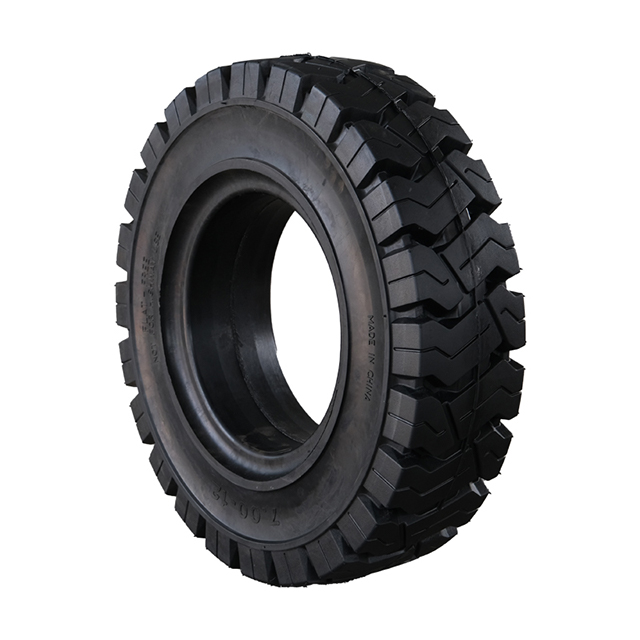
Matching the tire to the machine requires decoding the load index and standard sizing formats. Industrial tire sizes often appear in formats like 7.00-15. In this example, 7.00 represents the approximate tire width in inches, and 15 indicates the rim diameter. Reading industrial tire load charts involves cross-referencing these dimensions with the specific operating speed and position on the vehicle. You cannot simply mount a tire because it fits the rim; it must meet the engineering specifications of the axle it sits on.
Rim width and tire profile directly impact the maximum load-carrying capacity. A wider rim provides a broader base of support, increasing lateral stability during heavy lifts. You must differentiate between static load capacity and dynamic load capacity. Static capacity dictates how much weight the tire can support while the machine is stationary and actively lifting. Dynamic capacity dictates the safe weight limit while the vehicle is moving. Dynamic ratings are always lower because motion introduces lateral forces, braking friction, and heat.
Load Type | Definition | Primary Stress Factors | Operational Context |
|---|---|---|---|
Static Load | Maximum weight supported while stationary. | Vertical compression, sidewall bulge. | Lifting pallets, loading racks, stationary craning. |
Dynamic Load | Maximum weight supported while in motion. | Heat buildup, lateral sheer, braking torque. | Transporting materials across warehouses or yards. |
Heat generation remains the most destructive force acting on solid rubber. Continuous operation without adequate cooling periods breaks down the structural integrity of the tire compound. Rubber acts as an insulator. As the tire flexes under a heavy load, internal friction generates heat. Because the solid core cannot vent this heat like an air-filled tire, the core temperature rises rapidly. If the internal temperature exceeds the compound's thermal limit, the rubber undergoes a process called reversion. It begins to melt from the inside out, turning back into a gummy state, which leads to a catastrophic blowout.
You must respect the critical relationship between load ratings and speed ratings. Every load chart specifies the maximum speed a tire can safely sustain under full capacity. Exceeding this speed, even for short bursts, accelerates thermal degradation. To prevent this, calculate your specific duty cycles using these steps:
Measure the exact distance of your longest continuous travel route in the facility.
Calculate the average speed the machine travels while fully loaded.
Track the number of continuous operating hours per shift without a cool-down period.
Weigh the heaviest typical load the machine transports during that shift.
If your facility runs 24/7 with long travel runs, you need a tire compound engineered for high thermal resistance rather than just maximum raw lifting capacity.
Different industrial vehicles distribute weight in entirely different ways. Forklifts and container handlers experience massive load disparities between the drive axles and steer axles. When a forklift carries a heavy pallet, the front drive axle supports nearly the entire weight of the machine plus the load. The rear steer axle acts merely as a counterbalance. Conversely, when the forklift travels empty, the heavy rear counterweight shifts the burden to the steer tires. This constant shifting requires tires that can handle rapid cycles of compression and release.
Mast tilt and attachment weight further alter the center of gravity. Tilting a heavy load forward concentrates extreme localized stress on the front edge of the forklift solid tires. This action compresses the rubber aggressively against the floor, requiring a highly resilient tread compound to resist tearing. Heavy attachments like paper roll clamps or side-shifters permanently reduce the net lifting capacity and keep constant static pressure on the front axle. You must factor the weight of the attachment into your baseline load calculations before selecting a tire.
Skid-steer loaders and wheel loaders operate under entirely different mechanical principles. Skid-steers turn by locking one side of the drivetrain and dragging the tires across the surface. This high-torque steering mechanism requires incredibly aggressive tread patterns and stiff sidewalls. The tires must facilitate pushing heavy piles of dirt or debris while resisting severe sidewall damage from rocks and curbs. A standard smooth tread will fail rapidly under the shearing forces generated by a skid-steer. The rubber will literally rip off the casing during a zero-degree turn on dry asphalt.
Wheeled excavators and underground mining equipment demand extreme durability. These machines operate in confined, debris-heavy spaces where sharp rocks and jagged metal are constant threats. They require specialized compounds capable of supporting continuous, heavy loads over highly abrasive surfaces. Standard rubber compounds tear easily in these environments. High-tensile strength and deep lug patterns are mandatory for survival. The tires must also resist the lateral sway that occurs when an excavator swings a loaded bucket over the side of the chassis.
The ground surface dictates the required rubber compound and tread design. Smooth indoor concrete, typical in warehouses and logistics centers, presents specific challenges. If you operate in food-grade or pharmaceutical facilities, you must evaluate non-marking tire compounds. Standard black rubber leaves carbon dust and skid marks on sealed floors. Non-marking tires use silica instead of carbon black, keeping floors clean while maintaining similar traction levels. However, silica compounds often wear slightly faster than carbon black, requiring closer monitoring.
Polished indoor floors also introduce traction and static issues. Smooth surfaces offer low rolling resistance, which saves battery life on electric equipment, but they can become dangerously slick when wet or dusty. Furthermore, the continuous friction of rubber on epoxy floors generates static electricity. In environments handling volatile chemicals or sensitive electronics, you must use anti-static tire variants. These tires contain specialized conductive bands that ground the machine safely to the floor, preventing sparks that could ignite airborne dust or fumes.
Uneven outdoor terrain in yards and ports changes the physics of tire wear. When a heavy machine rolls over gravel, asphalt, or debris, it experiences point loading. Instead of the vehicle weight spreading evenly across a flat footprint, surface high points concentrate the entire load onto isolated tread blocks. This intense, localized pressure causes standard rubber to fracture. A single two-inch rock can temporarily bear the entire 8,000-pound weight of that wheel corner.
To survive point loading, you need deep-tread designs engineered to resist rapid tread chunking and tearing. Large, blocky tread lugs distribute the impact over a wider area and provide the necessary grip to navigate loose surfaces. A smooth or shallow-tread tire will quickly lose chunks of rubber when subjected to the harsh realities of an unpaved lumber yard or a deteriorating asphalt shipping terminal.
Severe hazard environments like scrap yards, foundries, and mining operations destroy standard tires in days. In these applications, you must assess specialized puncture proof solid tires. Scrap yards are littered with jagged steel and sharp debris that will shred normal rubber. Foundries expose equipment to extreme ambient temperatures and hot slag, requiring specialized heat-resistant compounds that will not melt or ignite when rolling over hot metal.
Standard solid rubber has strict limitations when exposed to continuous chemical spills or cutting fluids. Petroleum-based fluids degrade natural rubber rapidly, causing it to swell, soften, and fall apart. If your machines operate in machining centers or chemical plants, you must specify industrial solid tires molded from polyurethane or synthetic oil-resistant compounds to ensure operational longevity. Polyurethane offers massive load-bearing capabilities and complete resistance to oil degradation, though it provides less traction on wet surfaces.
The market offers distinct categories of solid construction, each engineered for specific operational profiles. Resilient solid tires, often called standard solids, serve as the most common drop-in replacements for pneumatic rims. They feature a distinct three-layer construction. The hard base layer contains steel wires to grip the rim tightly and prevent slippage. The middle cushion layer absorbs shock and dissipates heat. The outer tread layer provides traction and wear resistance.
Resilient tires work best for heavy-duty forklifts and wheel loaders operating in mixed indoor and outdoor environments. Because they mount onto standard multi-piece pneumatic rims, you can upgrade a machine without buying entirely new wheel assemblies. They offer excellent durability and a comfortable ride compared to harder alternatives. The installation requires a heavy-duty hydraulic press and specific locking rings to secure the tire to the multi-piece wheel.
Press-On Band (POB) tires utilize a simpler, highly effective construction. Manufacturers bond a solid rubber profile directly to a cylindrical steel band. These tires are pressed onto the machine's wheel hub using high-tonnage hydraulic equipment. POB tires handle exceptionally high load capacities while maintaining a very low profile. The interference fit between the steel band and the cast iron wheel hub ensures the tire will not slip under extreme torque.
You will primarily use POB tires on high-capacity, low-clearance indoor material handling equipment. Because they have very little sidewall flex, they offer unmatched lateral stability when lifting heavy loads to extreme heights. However, their rigid nature makes them unsuitable for rough outdoor terrain, as they transfer every bump directly into the chassis. Running a POB tire on broken asphalt will quickly destroy the wheel bearings and rattle the machine apart.
Cushion solid tires bridge the gap between load capacity and operator comfort. These designs feature engineered apertures—specifically shaped holes molded directly into the sidewall. These apertures allow the rubber to flex and compress under load, mimicking the shock absorption of a pneumatic tire without the risk of a puncture. The geometry of these holes, whether round or teardrop-shaped, prevents stress fractures from forming in the rubber during heavy compression.
Choosing aperture designs involves specific trade-offs. You gain significantly increased operator comfort and reduced chassis wear, which extends the life of your axles and mast chains. However, the empty space in the sidewall slightly reduces the maximum load capacity and lateral stability compared to a solid, non-apertured tire. They are the ideal choice for operations transitioning from air-filled tires but dealing with moderately rough surfaces like cracked concrete or packed dirt.
Upgrading your fleet requires careful planning to avoid secondary mechanical failures. The primary risk of switching from pneumatic to solid rubber is the drastic increase in vibration transmission. Without air to absorb impacts, the kinetic energy travels straight into the machine. This vibration loosens bolts, damages sensitive electronics, and accelerates wear on bearings.
To mitigate equipment wear, you must implement stricter maintenance schedules. Inspect axles, wheel bearings, and mast chains more frequently. Ensure operators slow down when crossing dock plates or expansion joints. If your facility has exceptionally rough transitions, strongly consider aperture-style tires to restore some shock absorption and protect the drivetrain.
Installation and maintenance realities also present significant risks. You cannot install these tires with standard garage tools. Improper pressing leads to tire slippage on the rim under high torque, which will destroy the base layer of the tire and potentially damage the wheel hub. You must utilize specialized hydraulic tire presses—often exceeding 120 tons of force—and trained technicians to ensure the tires seat perfectly.
Factor installation logistics into your procurement timeline. Because pressing requires heavy machinery, you either need a mobile tire press service to visit your site or you must ship your wheels to a specialized facility. Plan for this downtime to avoid disrupting your daily material handling schedules.
Train your maintenance team on premature wear identification. Catching a failing tire early prevents catastrophic blowouts and accidents. Provide your team with a clear diagnostic checklist:
Radial cracking along the sidewall indicates severe overloading or running the machine beyond its rated capacity.
Rapid center wear on the tread indicates excessive speed and internal heat buildup, requiring a compound change or a reduction in duty cycle intensity.
Severe chunking or tearing of the tread blocks indicates a surface mismatch, meaning the tire is too soft for the rough terrain it is navigating.
Uneven wear on one side of the tire suggests a bent axle or severe misalignment in the steering geometry.
Spinning on the rim indicates a failed interference fit, usually caused by improper pressing or extreme braking forces.
The optimal solid tire is always a calculated compromise between maximum load capacity, surface durability, and thermal management. You cannot maximize all three variables simultaneously. By understanding the physical limitations of rubber compounds and the specific mechanical demands of your equipment, you can select a tire that drastically reduces maintenance downtime and improves workplace safety. When shortlisting options, prioritize the load index and vehicle type first to ensure baseline safety and OEM compliance. Next, filter your choices by surface condition to select the correct tread pattern and compound. Finally, refine your selection by evaluating your duty cycle to ensure the tire can handle the heat and speed of your daily operations.
Take the following actions to optimize your fleet:
Audit your current tire failure modes to identify whether heat, point loading, or overloading is causing premature wear.
Document your exact vehicle OEM specifications, including maximum lift heights, attachment weights, and required load indices.
Map out the exact travel routes and surface transitions your machines navigate daily to determine the need for aperture designs or aggressive treads.
Consult with a technical tire specialist to conduct a comprehensive site survey and match your operational data to the correct rubber compound.
A: You determine maximum load capacity by consulting the manufacturer's load chart. Cross-reference the tire size, rim width, and specific vehicle application. The chart provides distinct weight limits for drive wheels versus steer wheels and specifies limits based on maximum travel speeds. Always factor in the weight of heavy attachments, as they permanently reduce your net lifting capacity.
A: In the 7.00-15 format, the first number represents the approximate width of the tire in inches. The second number indicates the diameter of the wheel rim in inches that the tire is designed to fit. This standard sizing helps match replacement tires to existing pneumatic rims without requiring new wheel assemblies.
A: Tread chunking occurs when tires operate on severely uneven surfaces or debris. The weight of the machine concentrates on isolated high points, causing point loading. This intense, localized pressure exceeds the tensile strength of the rubber, causing pieces of the tread to tear away from the tire body. Deep-tread designs help mitigate this damage.
A: Yes, you can install resilient solid tires on machinery originally equipped with pneumatics. These tires are specifically designed to mount onto standard multi-piece pneumatic rims. However, you must prepare for increased vibration and adjust your maintenance schedules to account for the loss of air cushioning, which transfers more shock to the chassis.
A: Press-on band tires consist of a rubber profile bonded directly to a steel cylinder, offering high load capacity and a low profile for indoor use. Resilient tires feature a three-layer rubber construction and fit onto standard pneumatic rims, making them better suited for mixed indoor and outdoor environments with uneven terrain.
A: You must replace the tires when the tread wears down to the 60-J line, also known as the safety line, molded into the sidewall. Operating past this line compromises the tire's structural integrity, reduces load stability, and violates safety regulations set by OSHA and equipment manufacturers.


