TAFU

- All
- Product Name
- Product Keyword
- Product Model
- Product Summary
- Product Description
- Multi Field Search

Views: 0 Author: Site Editor Publish Time: 2026-09-23 Origin: Site


Tire failure in industrial settings rarely stems from manufacturing defects. It usually results from miscalculating dynamic load factors, application intensity, and environmental variables. Selecting the right tire goes far beyond checking static weight limits on a spec sheet. Continuous shifts, uneven surfaces, aggressive driving styles, and heavy attachments drastically alter the actual stress placed on equipment. This mismatch leads to premature wear, safety hazards, and unplanned downtime across your operation.
This guide provides a technical framework for fleet managers and procurement specialists. You will learn how to accurately assess load requirements and calculate true capacity needs. We will help you specify the correct Solid Tires for your specific operational environments. By understanding the physics of weight transfer and thermal degradation, you can eliminate structural tire failures and keep your machinery running at peak performance.
Static vs. Dynamic Loads: Raw equipment and payload weight only establish the baseline; dynamic forces during lifting, braking, and cornering dictate the true load capacity required.
The Heat Variable: Application intensity (shift length, travel distance, and speed) generates internal heat, which is the primary degrading factor for solid tire load capacity over time.
Surface and Stability Impact: Different operating environments and soil types require specific tire profiles—resilient solid tires for shock absorption on uneven terrain, and press-on bands for maximum load stability in high-reach warehouse applications.
Static load represents the stationary weight of the machine plus its maximum payload. This number forms the absolute baseline for tire selection. However, static measurements fail to account for the reality of moving machinery. Once a forklift or loader begins to travel, dynamic load multipliers take over. Momentum, braking, and cornering shift the center of gravity rapidly. This shift exponentially increases the weight borne by the front drive axles or the rear steer axles.
Consider the standard load distribution ratio on a counterbalance forklift. A 10,000-pound machine carrying a 5,000-pound load weighs 15,000 pounds total. When the machine is fully loaded and the mast is tilted forward, the weight shift often hits an 80/20 distribution. The front tires bear almost the entire weight of the machine and the payload, roughly 12,000 pounds. Sudden braking while carrying that heavy load forces an even more aggressive forward weight transfer. This momentary spike in downward force represents the true dynamic load your tires must survive.
Solid rubber construction handles these extreme dynamic loads far better than pneumatic alternatives. Pneumatic tires rely on internal air pressure to maintain their shape and load-bearing capacity. Under sudden, massive load shifts, pneumatics face the risk of air pressure loss, sidewall blowouts, or catastrophic compression. Solid rubber eliminates these risks entirely. The dense rubber matrix absorbs the dynamic spike without collapsing, ensuring the machine remains upright and stable during aggressive maneuvers.
Tire deflection refers to the physical compression of the rubber under weight. It plays a direct role in maintaining a stable contact patch with the ground. You face a mechanical trade-off when evaluating deflection rates. Minimal deflection ensures high-mast lifting stability. When a reach truck raises a heavy pallet thirty feet into the air, even a quarter-inch of compression at the tire translates to several inches of sway at the top of the mast. Stiff rubber prevents this dangerous pendulum effect.
Zero deflection creates entirely different mechanical problems. Industrial equipment typically lacks a traditional suspension system. The tires act as the sole shock absorbers for the entire machine. If the rubber is entirely rigid, it transfers damaging shock loads directly to the equipment's chassis. Axles, bearings, and hydraulic seals absorb the impacts from uneven floors, dock plates, and debris. Finding the exact right deflection rate prevents structural fatigue while maintaining safe lifting parameters.
Engineers control deflection through the tire's compound formulation and physical profile. High-durometer rubber resists compression, making it ideal for smooth indoor surfaces where stability is paramount. Multi-layer resilient designs incorporate a softer middle core. This core allows controlled deflection to absorb impacts on rough outdoor terrain. Matching the deflection rate to your specific lifting heights and surface conditions remains a mandatory step in the sizing process.
Calculating the baseline weight requires a strict, comprehensive formula. You must combine the unladen equipment weight, the maximum rated payload, and the exact weight of all specialized attachments. Attachments alter the math significantly. Paper roll clamps, rotators, and side-shifters add massive dead weight to the front carriage. A standard paper roll clamp can weigh over 1,500 pounds alone.
More importantly, attachments push the load center further away from the fulcrum point of the front axle. Moving the load center from 24 inches to 36 inches artificially magnifies the downward force exerted on the front tires. This extended load center requires heavy duty solid tires built with reinforced sidewalls and exceptionally high load indexes. Standard compounds will squish and deform under the leveraged weight of a heavy clamp attachment. Upgrading to a premium heavy-duty compound ensures the tire maintains its structural integrity and handles the magnified dynamic forces without chunking.
Your calculations must always align with the absolute heaviest load the equipment will ever handle. Never use average daily loads for sizing purposes. If a machine handles 2,000-pound pallets most of the day but occasionally lifts a 5,000-pound die cast mold, you must spec the tires for the 5,000-pound lift. Designing around averages guarantees eventual tire failure during peak load events. The rubber will simply compress beyond its structural limit, leading to internal tearing.
Application intensity depends on continuous operation hours and the number of shifts worked per day. A single-shift operation running eight hours a day differs vastly from a 24/7 logistics facility. Rubber possesses unique thermal dynamics known as hysteresis. As the tire rolls and deflects under a heavy load, internal friction generates heat. Because solid rubber is thick and dense, it acts as an insulator and cannot dissipate this internal heat easily into the surrounding air.
Continuous rolling under heavy loads causes temperatures inside the tire core to skyrocket. High internal temperatures temporarily lower the tire's effective load capacity. Around 250 degrees Fahrenheit, the vulcanization bonds within the rubber begin to break down. The core melts and expands. This expansion creates internal pressure that eventually blows out through the sidewall, a failure known as a thermal blowout.
To combat the heat factor, you must evaluate travel distances and cycle times. Short, intermittent runs allow the rubber to cool between lifts. Long travel runs over 500 meters per cycle sustain load bearing for extended periods, building dangerous levels of heat. High-intensity applications require specialized cool-running rubber compounds. These formulations reduce internal friction and dissipate heat more efficiently, preserving the tire's load capacity during continuous, multi-shift operations.
Surface friction and soil types directly impact rolling resistance, traction, and load strain. Smooth, sealed concrete creates entirely different mechanical demands than rough asphalt, compacted dirt, or loose gravel. On smooth concrete, the primary concern is load stability and minimizing rolling resistance to conserve battery life. The tire must maintain a massive, flat contact patch to distribute the heavy loads evenly across the floor.
Rough surfaces introduce micro-abrasions and continuous impact shocks. Operating on damaged asphalt or gravel forces the tire to absorb constant vibrations. These impacts strain the rubber compound and accelerate tread wear. If you operate heavy machinery on loose soil, the tires must feature aggressive tread patterns to maintain traction. Aggressive treads reduce the total surface area of rubber touching the ground, which technically lowers the maximum load stability compared to a smooth tire.
Surface Type | Rolling Resistance | Impact Shock Level | Recommended Tread Profile | Load Capacity Impact |
|---|---|---|---|---|
Smooth Concrete | Very Low | Minimal | Smooth / Non-Traction | Maximum stability and load bearing |
Rough Asphalt | Medium | Moderate | Standard Lug | Slight reduction due to vibration strain |
Compacted Gravel | High | High | Deep Traction Lug | Requires higher safety margin for impacts |
Steel Decking | Low | Severe (at joints) | Smooth / Cut-Resistant | High risk of chunking; requires tough compound |
Travel distance acts as a multiplier for surface conditions. Dragging a heavy load across a rough yard for a quarter-mile generates immense friction and heat. The continuous strain tests the bond between the rubber and the steel wheel rim. High-torque applications on high-friction surfaces can actually cause the tire to spin on the rim if the interference fit is not perfectly calibrated. Evaluating the exact surface route prevents these catastrophic mechanical separations.
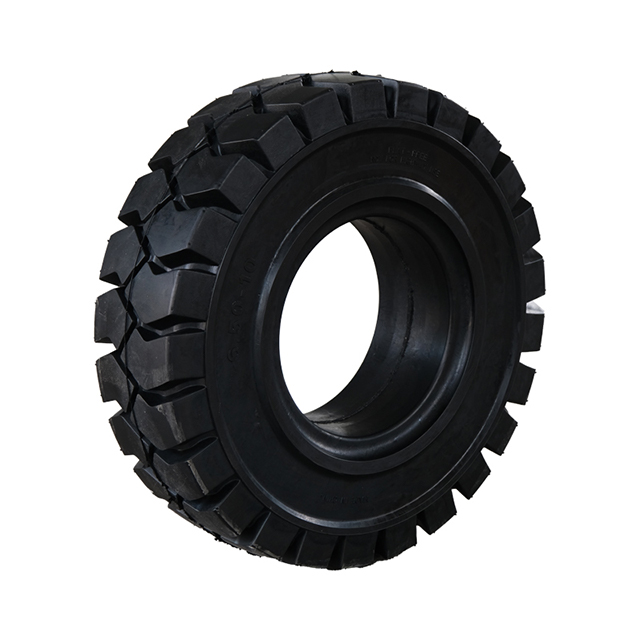
Press-on band (POB) tires consist of a solid rubber ring bonded directly to a steel band. This steel band is then pressed onto the equipment's hub under immense hydraulic pressure. POB tires offer an exceptionally high load capacity per square inch of rubber. They feature a low profile and minimal deflection. This makes them ideal for smooth indoor floors and heavy lifting applications where maximum stability is required.
Resilient solid tires, also known as solid pneumatics, feature a multi-layer construction. They typically include a tough outer tread, a softer middle cushion layer, and a rigid base layer reinforced with steel creel beads. This layered design provides superior shock absorption. Resilient tires excel on mixed surfaces, rough outdoor yards, and varying soil types where impact dampening is just as important as load bearing.
Choosing between the two depends entirely on your primary load factor and operating environment. Use the following comparison to guide your specification process:
Feature | Press-On Band (POB) Tires | Resilient Solid Tires |
|---|---|---|
Primary Environment | Indoor, smooth concrete floors | Outdoor, mixed surfaces, rough terrain |
Load Capacity | Extremely high per square inch | High, but requires larger physical dimensions |
Deflection & Stability | Minimal deflection, maximum high-mast stability | Moderate deflection, excellent shock absorption |
Equipment Compatibility | Requires specific POB hubs | Fits standard pneumatic split or multi-piece rims |
Heat Dissipation | Lower due to dense, low-profile rubber | Better due to larger surface area and cushion layer |
Indoor, narrow-aisle, and high-reach environments demand strict stability protocols. When a reach truck extends a heavy pallet into racking systems thirty feet high, the margin for error disappears. warehouse solid tires prioritize a wide, flat profile. They use high durometer rubber compounds formulated for maximum rigidity. This hardness eliminates lateral sway during extreme vertical lifts.
The contact patch of a warehouse tire must remain perfectly uniform. Any crowning or uneven wear creates a pivot point. A pivot point allows the machine to rock slightly from side to side. While a quarter-inch rock at the floor seems minor, it amplifies into dangerous instability at the top of the mast. Smooth tread patterns are standard in these environments because they put the maximum amount of rubber in contact with the floor, distributing the immense point-loads safely.
Warehouse environments often require non-marking compounds. Standard black rubber leaves carbon dust and skid marks on sealed concrete floors. Non-marking tires replace carbon black with silica or chalk. While they keep floors clean, silica compounds can sometimes alter the thermal properties and wear rates of the tire. You must account for these subtle compound differences when calculating the lifespan and load limits of high-stacking warehouse equipment.
Towed equipment like baggage carts, heavy material trailers, and roll-on/roll-off platforms face unique load factors. Unlike forklifts, trailers do not lift loads; they carry them over long distances. industrial trailer solid tires must handle continuous rolling friction. They endure severe lateral drag during tight turns, especially on multi-axle setups where the wheels do not steer independently. This dragging effect is known as scrubbing.
Scrubbing tears at the tread blocks and generates immense lateral heat. The tires must feature specific tread patterns and cut-resistant rubber formulations to survive this continuous abuse. Sustained weight distribution across multiple axles requires tires that wear evenly. If one tire on a tandem axle wears faster than the others, it shifts the load burden onto the remaining tires, overloading them instantly and causing a cascading failure across the trailer.
Continuous cycle loads also mean the tires rarely get a chance to cool down. Baggage tractors at airports run constantly. The tires must feature advanced heat-dissipating core compounds. The sidewalls must be reinforced to handle the lateral forces of towing heavy loads around sharp corners at speed. Specifying the wrong profile for a trailer results in rapid tread delamination and frequent hub bearing failures due to excessive vibration.
Industrial tire sidewall markings reveal strict operational limits. You must understand how to read the load index, speed symbol, and ply-rating equivalents. The load index is a numerical code that corresponds to the maximum weight the tire can carry. The speed symbol indicates the maximum safe operating speed under that specific load. These two metrics are permanently intertwined and cannot be evaluated separately.
Speed and load capacity share a strict inverse relationship. A tire rated for 10,000 lbs at 5 mph might only safely carry 7,500 lbs at 15 mph. As speed increases, internal heat generation spikes, and the rubber's structural integrity decreases. You must calculate your load limits based on the maximum speed your operators actually drive, not the theoretical crawl speed listed on the spec sheet. Ignoring the speed index guarantees thermal degradation.
Locate the size designation on the sidewall to confirm physical dimensions.
Identify the load index number and cross-reference it with the manufacturer's weight chart.
Find the speed symbol to determine the maximum velocity for that specific load.
Check the ply-rating equivalent to gauge the density and stiffness of the base compound.
Always check the equipment manufacturer's specifications for exact load ratings and approved tire dimensions. Altering tire size dimensions changes the load geometry of the entire machine. Modifying the outer diameter, inner diameter, or width away from OEM specs compromises lifting capacity. It directly impacts operational safety and can void the equipment's warranty.
Installing a tire with a smaller outer diameter lowers the machine's ground clearance. This increases the risk of bottoming out on dock plates and ramps. It changes the gear ratio of the drive axle, forcing the transmission to work harder to achieve the same speed. Installing a narrower tire reduces the contact patch, which drastically lowers the machine's lateral stability during high lifts.
The inner diameter must perfectly match the wheel rim. Solid tires rely on an extreme interference fit to stay on the wheel. If the tire's inner diameter is even slightly off, the tire will spin on the rim under heavy torque. This slippage destroys the base rubber and renders the tire useless. Never deviate from OEM size specifications without consulting a certified mechanical engineer.
Implement standard engineering safety margins for all load calculations. Aim for 10 to 15 percent above the calculated maximum dynamic load. This buffer protects against unexpected variables. Operators occasionally pick up loads slightly heavier than anticipated. Floors develop potholes that cause sudden impact spikes. A 15 percent safety margin ensures the tire absorbs these anomalies without suffering structural damage.
Adjust these calculations based on environmental extremes. Ambient temperature plays a massive role in rubber performance. Cold storage facilities preserve rubber integrity better, allowing tires to run cooler. Freezing temperatures make the rubber brittle, increasing the risk of chunking upon impact. High-heat foundries or outdoor yards in summer climates prevent the tire from cooling down, requiring an even larger safety margin to prevent thermal blowouts.
Chemical exposure also dictates safety margins. Facilities processing oil, grease, or harsh solvents degrade standard rubber compounds rapidly. The chemicals break down the vulcanization, softening the tire and lowering its effective load capacity. In these environments, you must spec oil-resistant compounds and increase your load safety margin to account for accelerated chemical wear.
Overloaded tires display clear, undeniable physical signs of distress. Recognizing these wear patterns early prevents catastrophic failures. Look for radial cracking along the sidewalls. These deep, horizontal cracks indicate that the tire is compressing beyond its structural limit, stretching the rubber until it tears. Radial cracking means the tire is bearing too much dynamic weight or the deflection rate is too high for the application.
Chunking occurs when large, jagged pieces of rubber tear away from the tread face. This usually happens when an overloaded tire strikes debris or a sharp dock plate edge. The excessive weight forces the rubber to snag and rip rather than roll over the obstacle. Tread separation is another severe indicator. The outer tread layer literally peels away from the cushion core due to extreme heat buildup and sheer force.
Accelerated center wear indicates a severe load mismatch on crowned surfaces. If the tire wears completely smooth in the center while the outer edges remain intact, it means the tire is ballooning under speed and heat, concentrating all the weight on the center line. Monitoring these physical signs allows you to adjust your load calculations before the next procurement cycle.
Incorrect load matching carries heavy secondary costs that extend far beyond the price of replacement rubber. Overloaded, failing tires transfer immense strain to the equipment. When a tire loses its shape or chunks heavily, it creates a severe vibration through the chassis. This vibration destroys wheel bearings, blows out hydraulic seals on the mast, and cracks axle housings. The cost of replacing a drive axle dwarfs the cost of buying the correct tires.
Compromised tire integrity also increases whole-body vibration (WBV) for the operators. WBV is a serious occupational hazard. Driving a forklift with chunked or overloaded tires feels like operating a jackhammer. The constant jolting travels up through the seat and directly into the operator's spine.
Prolonged exposure to high WBV causes severe lower back pain, chronic fatigue, and reduced concentration. Fatigued operators make mistakes. They drop loads, hit racking systems, and drive aggressively to finish shifts faster. Ensuring your tires are properly rated for the load and surface provides a smooth ride, protecting both your machinery and your workforce.
Conduct regular site audits to mitigate load risks effectively. You cannot manage what you do not measure. Track the exact weights being lifted, the distances traveled, and the condition of the floor surfaces. Transition to non-marking or specialized compounds immediately if environmental factors change. If a warehouse expands and requires longer travel runs, the tires that worked last year will fail this year.
Strictly monitor operator driving styles. Aggressive habits artificially spike dynamic loads. Harsh braking throws the entire weight of the machine forward, grinding the steer tires into the concrete. Rapid acceleration spins the drive tires, generating massive friction and heat. Sharp cornering at speed forces the machine to lean, overloading the outside tires and risking a tip-over.
Install telematics systems to track harsh braking and cornering events.
Implement strict speed limits within the facility to control heat buildup.
Train operators on the physical limits of their equipment and the dangers of dynamic weight transfer.
Perform weekly visual inspections of all tires to catch radial cracking and chunking early.
Rotate tires if uneven wear patterns emerge due to specific route geometries.
Upgrade to premium, heat-resistant compounds for any machine running more than two consecutive shifts.
Pull the OEM spec sheet for every machine in your fleet to verify the factory-mandated tire dimensions and load ratings.
Weigh your heaviest attachments and calculate the extended load center to establish your absolute peak dynamic weight.
Install telematics or conduct a physical site audit to record actual travel speeds, route distances, and floor conditions.
Specify heat-resistant rubber compounds for any equipment operating continuously for more than eight hours per day.
A: You calculate load capacity by combining the unladen weight of the machine, the maximum payload, and the weight of any attachments. You must then factor in dynamic multipliers for braking and cornering, and apply a 10 to 15 percent safety margin based on operating speeds and environmental conditions.
A: Consistent overloading causes severe heat buildup, leading to internal core melting and thermal blowouts. Physically, the tire will exhibit radial cracking along the sidewalls, heavy chunking of the tread, and rapid structural degradation that transfers damaging vibrations to the equipment's axles.
A: It depends on the environment. Press-on band (POB) tires offer higher load capacity per square inch and maximum stability for smooth indoor floors. Resilient solid tires are better for heavy loads on rough outdoor surfaces because their multi-layer construction provides necessary shock absorption.
A: Speed and load capacity have an inverse relationship. As travel speed increases, internal friction generates excessive heat, which softens the rubber and lowers its structural strength. A tire rated for a specific weight at 5 mph will have a significantly lower safe capacity at 15 mph.
A: Yes. Attachments like clamps and rotators add significant dead weight to the front carriage. More importantly, they push the load center forward. This leverages more dynamic weight onto the front drive tires, requiring a higher load index to prevent failure.
A: Continuous operations prevent tires from cooling down between shifts. This sustained heat degrades standard rubber compounds rapidly. For 24/7 applications, you must select premium, cool-running rubber compounds designed specifically to dissipate heat and maintain load capacity under continuous strain.


