TAFU

- All
- Product Name
- Product Keyword
- Product Model
- Product Summary
- Product Description
- Multi Field Search

Views: 0 Author: Site Editor Publish Time: 2026-09-16 Origin: Site


Vehicle stability dictates safety and efficiency in material handling operations. Minor load shifts easily cause catastrophic tip-overs, and dropped materials halt production lines instantly while endangering personnel. Pneumatic tires introduce severe operational risks in high-capacity environments because they deflect, squish, and bounce under maximum loads. Navigating tight turning radii exacerbates this dangerous deflection, and debris-littered floors threaten immediate blowouts that lead to sudden load shifts. Solid Tires solve this fundamental engineering flaw by eliminating air pressure variables entirely. This creates a constant, predictable footprint on the ground. We will explore exactly which environments yield the highest stability returns and how these tires perform across fluctuating load conditions. Selecting the right compound directly impacts your operational safety, daily throughput, and the overall reliability of your material handling fleet.
Zero Deflection at Height: Solid tires provide superior mast stability for high-lift applications because their dense rubber construction eliminates the sidewall flex inherent in air-filled alternatives.
Environment-Specific Formulations: Smooth, indoor concrete floors favor press-on band tires, while resilient solid pneumatics are required for dependable traction on abrasive, debris-heavy outdoor yards.
Equipment Versatility: Beyond forklifts, integrating industrial trailer solid tires ensures synchronized, sway-free handling across multi-cart towing operations.
The Ergonomic Trade-Off: The stability gained from rigid rubber compounds transfers more shock to the chassis and operator, requiring specific mitigation strategies for uneven terrain.
Tire deflection occurs when load weight forces a tire to compress against the floor. Air-filled tires compress unevenly during heavy lifts. This uneven compression shifts the equipment's center of gravity. Solid rubber prevents this dangerous shifting. The tire maintains its exact structural shape under extreme pressure. Cornering becomes highly predictable. Lateral forces do not cause the sidewalls to buckle or fold. The physics of load transfer remain linear and controlled. Operators experience immediate feedback from the steering axle. This rigidity prevents the dangerous sway associated with heavy, off-center loads. When a forklift picks up a 5,000-pound steel coil, the weight transfers directly through the mast to the front axle. If the front tires compress, the mast tilts forward. This forward tilt changes the load center. Rigid rubber stops this compression. The mast stays perfectly vertical. The load center remains exactly where the manufacturer intended.
A constant contact patch improves traction significantly. Air-filled tires change their footprint based on internal pressure and external load. Rigid rubber maintains a uniform footprint at all times. This consistency maximizes grip on smooth surfaces. Steering response feels sharp and immediate. Asymmetrical loads often push equipment to lean heavily to one side. A uniform contact patch resists this lateral force. The equipment tracks straight and true. Operators spend less time correcting their steering angles. Consistent footprints also ensure even tread wear over the lifespan of the tire. Uneven wear leads to premature replacement and unstable handling. When a tire wears evenly, the forklift maintains a level stance. A level stance prevents the mast from leaning left or right during high lifts. You can measure this consistency by looking at the dust tracks left on a warehouse floor. A rigid tire leaves a perfectly uniform track, indicating even weight distribution.
Handling characteristics must remain stable across different load conditions. Operators drive empty forklifts differently than fully loaded ones. Rigid rubber ensures these handling characteristics do not change drastically. The center of gravity stays locked in place. An empty machine corners with the same stability as a loaded machine. This predictability reduces operator hesitation. It allows for smoother transitions between lifting and traveling. Sudden stops do not cause the chassis to dive forward. The suspension geometry functions exactly as the engineers intended. When an operator drops a heavy pallet and reverses, the sudden weight reduction causes air-filled tires to rebound. This rebound bounces the forklift. Rigid tires do not rebound. The forklift remains planted on the floor. This planted feeling gives operators the confidence to work faster and safer.
Compound density dictates the balance between grip and rigidity. Durometer ratings measure this rubber hardness precisely. High-durometer rubber provides maximum stiffness. This stiffness excels in high-lift applications where sway is unacceptable. However, harder rubber sacrifices a small amount of surface grip. Lower-durometer compounds offer better traction on slippery surfaces. They sacrifice a minor amount of rigidity to achieve this grip. Selecting the right durometer requires evaluating your specific floor conditions. Facilities with polished concrete often require specific compound blends to prevent wheel spin. A standard durometer rating for indoor warehouse tires sits around 70 to 80 on the Shore A scale. Outdoor tires might use a slightly softer compound to grip rough asphalt. You must match the compound to the primary operating surface. Using an ultra-hard indoor tire on wet outdoor asphalt leads to dangerous sliding. Using a soft outdoor tire on smooth indoor concrete leads to rapid wear and increased rolling resistance.
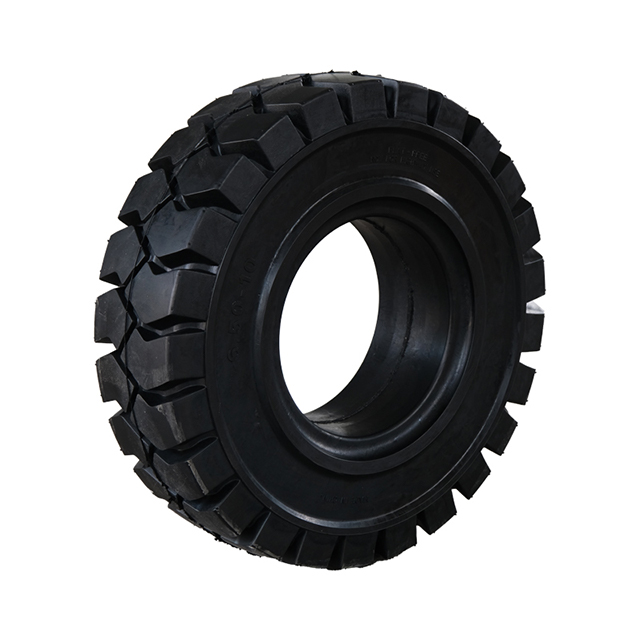
High-density storage demands absolute precision from material handling equipment. Lifting a 3,000-pound pallet 15 feet in the air amplifies minor chassis movements. A fraction of an inch of tire squish translates to several inches of mast sway. This sway terrifies operators and slows down cycle times. warehouse solid tires eliminate this dangerous mast sway. Press-on band tires dominate indoor reach truck fleets. They feature a steel band wrapped in highly dense rubber. This design deflects minimally under extreme vertical loads. Smooth, sealed concrete provides the perfect operating surface for these compounds. The lack of suspension travel ensures the forks remain perfectly level during high rack insertions. When an operator extends a reach mechanism, the weight shifts entirely to the front load wheels. These wheels must not compress. If they compress, the pallet catches on the racking. Rigid rubber ensures the pallet slides smoothly into the designated slot.
Narrow aisle navigation requires tight, precise maneuvers. Equipment must turn within inches of steel racking. Reduced physical tire profiles allow for sharper turning radii. The vehicle maintains its center of gravity perfectly during these tight turns. Operators maneuver with much higher confidence. Confined warehouse spaces become easier and faster to navigate. Speed and efficiency increase naturally when operators trust their equipment. The rigid sidewalls prevent the chassis from leaning into the racks during sharp cornering. This protects both the inventory and the storage infrastructure from accidental impacts. Wire-guided and rail-guided turret trucks rely heavily on this dimensional stability. If a tire compresses unevenly, the truck loses its alignment with the guidance system. This misalignment causes the truck to shut down automatically. Rigid rubber maintains the exact ride height required for these automated systems to function flawlessly.
Scrap yards, steel mills, and glass manufacturing plants destroy standard tires. These debris-heavy zones require absolute puncture-proof construction. A sudden blowout under a heavy load causes immediate, dangerous instability. The forklift tilts violently toward the blown tire. Loads drop, and the equipment sustains severe damage. heavy duty solid tires prevent these catastrophic failures entirely. They maintain handling integrity when rolling over sharp metal. Glass shards and industrial slag do not compromise their internal structure. Operations continue without stopping for emergency tire repairs. The structural integrity remains intact regardless of surface hazards. In a lumber yard, stray nails and splintered wood constantly threaten tire integrity. A rigid tire rolls over these hazards without losing pressure. The operator does not even feel the puncture. The tire continues to support the load safely. This reliability keeps production moving in the harshest industrial environments.
Abrasive surfaces demand specific tire engineering. Resilient solid pneumatics provide dependable traction in these environments. They conquer cracked asphalt, uneven concrete, and gravel yards. Loading docks often feature transition plates and wide expansion joints. Layered tire construction absorbs these minor surface irregularities effectively. A rigid base locks securely onto the steel rim. A softer center layer provides limited but necessary shock absorption. The tough outer tread resists tearing, chunking, and rapid wear. The load platform remains highly stable across this rough terrain. Operators maintain control even when navigating deep potholes or degraded asphalt. When a forklift transitions from a smooth warehouse floor to a rough outdoor yard, the tires must adapt instantly. The layered construction allows the tread block to flex slightly, gripping the uneven surface. This flex prevents the drive wheels from spinning out when pushing heavy loads up an incline.
Forklifts require massive vertical stability for lifting operations. Tow tractors demand horizontal tracking precision for pulling operations. The physics of these two applications differ completely. Forklifts must resist lateral sway when the mast is extended. Tow tractors must maintain traction while pulling dead weight from a standstill. Tow tractors do not lift loads high into the air. Their tires must prioritize forward grip and directional stability. The rubber compounds used for tow tractors often feature aggressive tread patterns. This ensures they can pull heavy loads across slick or wet surfaces without wheel spin. A tow tractor pulling 10,000 pounds of carts needs maximum friction at the drive axle. If the tires slip, the entire train stops. Rigid rubber with a deep lug pattern bites into the floor, transferring the motor's torque directly into forward motion.
Integrating industrial trailer solid tires ensures synchronized movement across multi-cart trains. These trains carry immense weight across sprawling manufacturing campuses. Air-filled tires on trailers cause lateral sway during transit. This leads to dangerous fishtailing at higher towing speeds. Rigid rubber prevents this sway entirely. Trailer casters and fixed axles require extremely high load-bearing capacities. Solid rubber supports these extreme weights without compressing or deforming. The entire multi-cart train moves as a single, stable unit. Cornering becomes predictable, preventing the rear carts from swinging wide and striking obstacles. When a tugger pulls five loaded trailers around a 90-degree corner, each trailer must follow the exact path of the one in front of it. Tire deflection causes the trailers to drift outward. Rigid tires keep the trailers tracking perfectly in line, protecting pedestrians and facility infrastructure.
Rigid rubber transfers more shock directly to the chassis. Operators feel every bump, crack, and expansion joint. This lack of an air cushion causes accelerated operator fatigue. Equipment wear also accelerates without proper shock mitigation. Vibrations loosen bolts and stress electronic components over time. Suspension seats absorb a significant portion of this shock. Installing anti-fatigue floor mats in the operator cabin helps immensely. Regular axle and bearing maintenance prevents premature component failure. Fleet managers must balance the need for absolute stability with operator comfort. You can implement several mechanical upgrades to offset this rough ride.
Upgrade to fully adjustable air-ride suspension seats.
Install vibration-dampening mounts under the operator cabin.
Enforce strict speed limits on rough outdoor terrain.
Conduct weekly inspections of steering linkages and tie rods.
Train operators to cross expansion joints at an angle rather than head-on.
Surface degradation presents another operational risk. High-durometer rubber can damage unsealed or aging concrete floors. Spalling occurs when rigid tires chip the top layer of the floor surface. Older concrete floors remain particularly vulnerable to heavy, pivoting loads. Non-marking tires offer a solution for clean or sensitive environments. They use silica compounds instead of traditional carbon black. Their handling characteristics match standard black rubber perfectly. However, they do not leave black scuff marks on sealed epoxy floors. Facilities must evaluate their floor coatings before selecting a compound hardness. If you operate in a food processing plant or pharmaceutical facility, floor cleanliness is mandatory. Standard black tires leave permanent marks during tight turns. Silica-based compounds eliminate this issue entirely. You must sweep the floors regularly, as silica tires can slip on heavy dust accumulations.
Selecting the correct compound requires a systematic evaluation of your facility. Use the following matrix to match tire types to specific operational demands.
Application Type | Load Weight & Variability | Surface Condition | Recommended Tire Type |
|---|---|---|---|
High-Lift Reach Trucks | High capacity, minimal variation | Smooth, sealed indoor concrete | Press-On Band (High Durometer) |
Outdoor Scrap/Lumber Yard | Maximum capacity, high variation | Debris-heavy, cracked asphalt | Resilient Solid Pneumatic |
Multi-Cart Towing | Heavy horizontal drag | Mixed indoor/outdoor transition | Resilient Solid (Aggressive Tread) |
Food & Beverage Warehousing | Medium capacity, fast cycles | Sealed epoxy, clean floors | Non-Marking Press-On Band |
Heavy Manufacturing | Extreme capacity, static loads | Steel plates, rough concrete | Polyurethane Press-On |
Press-on bands belong indoors on smooth surfaces. They offer the maximum possible lift stability. Their low profile and steel band construction eliminate nearly all deflection. Resilient solids provide indoor and outdoor adaptability. They handle rougher terrain like damaged asphalt and loading dock transition plates. They fit on standard pneumatic rims, making them versatile for mixed fleets. Choose press-on for height and precision. Choose resilient solids for durability and surface adaptability. When converting a forklift from pneumatic to solid, you must verify the rim type. Split rims require specific locking rings to secure resilient solids. Press-on bands require a hydraulic press to force the steel band onto the wheel hub. You cannot interchange these two types without changing the entire wheel assembly.
OSHA enforces strict regulations regarding forklift stability. Operators must keep the equipment's center of gravity within the stability triangle. Tire deflection shifts this center of gravity dangerously close to the triangle's edge. Rigid rubber keeps the center of gravity safely inside the required parameters. Upgrading to stiffer compounds often brings aging fleets back into strict safety compliance. Always verify that your chosen compound meets the equipment manufacturer's specifications for load handling. Modifying the tire type can alter the data plate requirements. If you change the tire diameter or width, you must contact the manufacturer for an updated capacity plate. Operating a forklift with an inaccurate data plate violates federal safety regulations.
To maximize stability and eliminate unpredictable load shifts in your material handling operations, you must transition to the correct rigid tire compounds. Follow these immediate steps to upgrade your fleet safely and effectively:
Assess your facility's primary surface conditions, mapping out any transition zones, damaged concrete, or outdoor debris fields.
Measure your maximum lift heights to determine if high-durometer press-on bands are required for mast stability.
Consult with a tire specialist to calculate the exact load capacities needed for your heaviest applications.
Implement ergonomic upgrades like suspension seats and anti-fatigue mats before transitioning a fleet from pneumatic to rigid rubber.
Update your equipment data plates through the manufacturer if changing tire dimensions to maintain OSHA compliance.
A: On smooth indoor concrete, smooth press-on bands provide superior traction due to a constant, wide contact patch. On rough outdoor asphalt, pneumatics offer better grip because they deform to grip uneven surfaces. Resilient solids offer a middle ground for mixed environments.
A: Standard indoor press-on tires should not be used outdoors. They lack the shock absorption needed for rough terrain and will degrade quickly. Outdoor applications require resilient solid pneumatics designed specifically for abrasive surfaces and weather exposure.
A: They do not increase the manufacturer's rated lifting capacity. However, they provide the rigid stability necessary to safely handle maximum-rated loads without experiencing dangerous mast sway or lateral chassis tipping.
A: They typically last three to five times longer than air-filled alternatives. The dense rubber resists chunking and tearing, and the complete elimination of punctures prevents premature tire failure entirely.
A: They lack the compressed air cushion that absorbs impacts. Every surface irregularity, crack, and bump transfers kinetic energy directly through the tire into the equipment chassis and the operator's seat.
A: No. Non-marking tires provide the exact same stability, load capacity, and deflection resistance as standard black rubber. The only difference is the use of silica instead of carbon black, which prevents floor scuffing.


